


In traditional Chinese Feng Shui, a home is viewed as a living entity that draws in the energy of heaven and earth. The main door acts as this entity’s “mouth and nose,” the most critical passageway for energy flow, known in Feng Shui as the “Qi Mouth.” The condition of the area directly in front of your door directly impacts the home’s ability to welcome positive energy (“Sheng Qi”) and block negative energy (“Sha Qi”). This, in turn, profoundly influences the occupants’ luck, health, wealth, and personal relationships. Therefore, creating a harmonious and orderly “Ming Tang” (the area in front of the door) is a vital aspect of Feng Shui. Here are some core issues to pay attention to regarding front door Feng Shui.
I. The Ming Tang Should Be Open and Spacious to Gather Energy
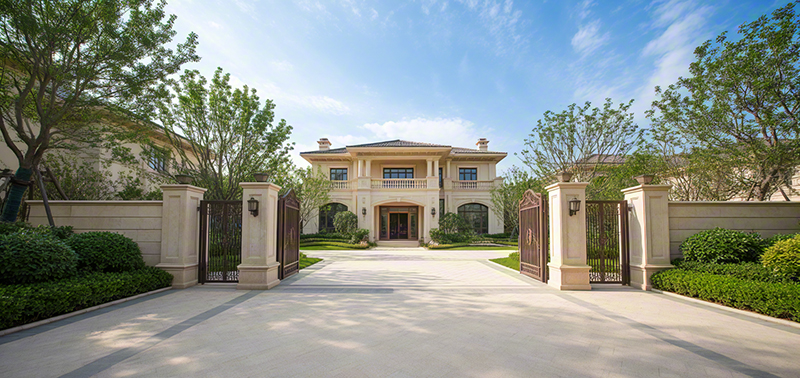
The “Ming Tang” refers to the open space directly in front of the main door. The primary principle for ideal front door Feng Shui is an “open and spacious Ming Tang.”
What’s Good: Open, Clean, and Tidy. There should be sufficient space in front of the door, with a clear, unobstructed view and no tall blocking structures. This symbolizes a bright future and smooth-sailing luck. Whether it’s the yard of a house or the shared hallway of an apartment, this area should be kept clean, tidy, and bright. An open Ming Tang helps “gather energy,” allowing auspicious energy to collect calmly before entering the home.
What to Avoid: Narrow and Oppressive. If the front door directly faces a high wall, a steep slope, or a narrow alley between buildings, it creates what’s known as “Oppression Sha” or “Piercing Heart Sha.” This setup feels stifling, can hinder career advancement, and may attract troublesome people or obstacles. Similarly, if a tall tree or utility pole is positioned directly in front of and very close to the door (known as “Piercing Heart Sha”), it can negatively impact the family’s health, particularly issues related to the heart and head.
II. Roads and Water Flow: Curves Are Favored
In Feng Shui, roads and water flows in front of the door are seen as pathways that guide the movement of “Qi,” and their shape is crucial.
Roads: Embrace is Good, Direct Assault is Bad. The most desirable road configuration is one that curves gently and embraces the front of the property, known as the “Jade Belt” formation, which promotes wealth and family prosperity. The most critical situation to avoid is a “Road Rush” (“Lu Chong”), where a long, straight road, corridor, or alley points directly at the main door. This setup creates a powerful and aggressive “Sha Qi” shooting straight at the entrance, which can lead to accidents, arguments, legal disputes, or dramatic financial ups and downs. If unavoidable, remedies like placing a “Taishan Stone,” a screen, or lush plants can help neutralize this effect.
Water Flow: Slow is Good, Fast or Bending Away is Bad. If there is a river or pond in front of the door, the water should be slow-moving, clear, and ideally curve around the property. Swift, noisy water, or water that forms a reverse arc (bending away from the home, like the outer edge of a bow) is considered very unlucky. This “Reverse Bow Water” is believed to cause financial loss and family separation.
III. Avoiding Negative Forms and Structures
In modern urban environments, various negative shapes, or “Form Sha,” are common and need to be carefully identified and avoided.
Avoid Sharp Corners and “Knife Blades”. If your main door directly faces the sharp corner of another building, a sharp advertising sign, or the sharp edge of a facing building’s wall (known as “Knife Blade Sha”), it creates a sharp “Fire Form Sha.” This can easily lead to family conflicts, arguments, and potential for injury or blood-related issues.
Stay Away from Filth and “Yin” Energy. The main door should not directly face places like garbage dumps, public restrooms, hospitals, or funeral homes, which are heavy with foul and “Yin” (negative, passive) energy. The polluted energy from these places charges straight into the home, severely affecting the family’s health and fortune. Similarly, it’s not advisable to have the door directly facing religious institutions like temples or churches, as their energy fields are considered too strong and unsuitable for ordinary residences.
Watch for Direct Alignment of Doors and Windows. If your main door is directly aligned with the back door or a large balcony window, it creates a “Piercing Through Sha.” The energy that enters rushes straight through and out, unable to settle and accumulate within the home. This leads to money coming in and going out just as quickly, making it hard to build savings. The solution is to place an entryway screen or partition in the middle to guide the energy on a more curved, harmonious path.
IV. The Door Itself: Substantial and Stable
The condition of the door itself directly reflects the “face” and energy of the home.
Size and Proportion: The door’s size should be proportionate to the overall scale of the house. A door that’s too large for a small house (causing energy to scatter) or a house that’s too large for a small door (restricting energy flow) are both problematic.
Swing Direction: The door should ideally swing inwards, symbolizing the drawing in of wealth and good fortune. A door that swings outwards is seen as pushing energy away.
Material and Color: Choose solid, sturdy materials to signify the stability of the home. The color should be selected based on the door’s direction and the homeowner’s elemental astrology (Wu Xing). For example, a door facing East or Southeast belongs to the Wood element, making green or black (Water nourishes Wood) suitable. A South-facing door belongs to Fire, making red or green (Wood generates Fire) good choices.
Maintenance and Cleanliness: The door must be kept in good condition, without damage or peeling paint. The door light should be bright, ensuring ample light in the doorway area to enhance “Yang” (active, positive) energy.
V. Enhancing Details: The Finishing Touches
After meeting the basic conditions above, some careful arrangements can add the final touches to your front door Feng Shui.
Placement of Auspicious Objects: You can place a pair of clean stone lions or “Qilin” creatures on either side of the door to guard the home and ward off negative energy. Placing auspicious plants like a Money Tree or Jade Plant inside the entryway can also stimulate vibrant energy.
Use of a Doormat: Placing a doormat inside the door is not only practical but is also believed in Feng Shui to have the function of “stepping on” negative energy. Its color can also be chosen according to Wu Xing principles.
Keep it Clutter-Free: The most critical point is to keep the area in front of the door and inside the entryway completely clear and unobstructed. Avoid piling up clutter there. A messy pile blocks the entry of energy, quite literally keeping the “Wealth God” from your door.
In summary, the core of front door Feng Shui lies in “Harmony” and “Vitality.” An open, clean, bright, and unobstructed Ming Tang, paired with a substantial, stable, and well-maintained door, is like a smiling, courteous host. It naturally draws in good fortune from all directions, bringing peace and prosperity to the home. The way of Feng Shui is about aligning with nature to create a living environment that feels comfortable, safe, and full of promise.





Leave a Reply