


In Feng Shui metaphysics, the direction of the entrance determines the flow of energy, and the main door is considered the focal point of a property’s Feng Shui. The Feng Shui of the main door influences the vitality of the home, the health and temperament of its occupants, and even their lifelong fortune. Therefore, the position, orientation, height, size, and appearance of the door are all of great importance.
Generally, it is ideal to position the main door on the left side of the house, as the left is known as the Qinglong position (Green Dragon). The Green Dragon is an auspicious symbol, representing protection and peace for the household.
However, if there is negative energy (Sha Qi) directly impacting the left side, the door may be placed on the right side, known as the Baihu position (White Tiger). In such cases, it is important to ensure that the access path outside the door remains on the left side, as this helps improve the Feng Shui and enhance the family’s fortune.
If there is a large, open flat area in front of the house—known as a “bright hall”—then it is suitable to position the door in the very centre. This is commonly referred to as a Zhuque door (Vermilion Bird Gate), as it facilitates the absorption of external energy gathered directly in front.
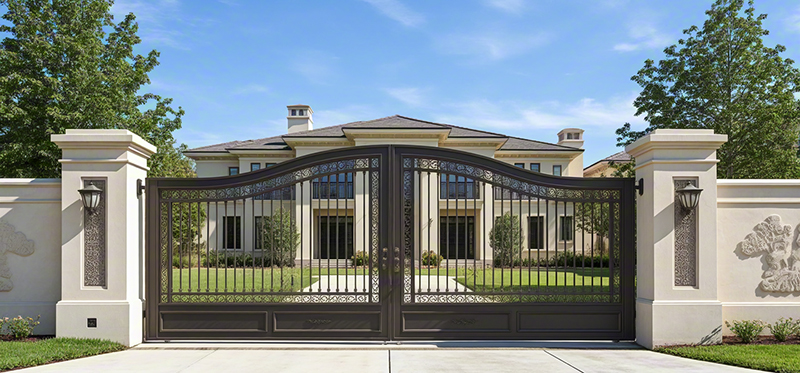
In modern society, with advanced transportation and roads built everywhere, travel has become more convenient. Feng Shui emphasises the origin and flow of energy, considering roads as water, with earthly energy flowing from high to low areas. If there is a road in front of the main door, and the right side is longer (representing the incoming water direction) while the left side is shorter (representing the outgoing water direction), it is advisable to position the door on the left front to draw in and capture the earthly energy.
In some areas, newly constructed roads may cause the main doors of certain houses to sit lower than the road level. This is considered highly unfavourable in Feng Shui, symbolising a pattern of continuous decline. When the door is lower than the road, vehicle exhaust fumes, dust, and dirt from the road can enter the house, bringing polluted energy that negatively affects the occupants’ health and career development.
If the main door directly faces a utility pole, it is considered an “Xuan Zhen Sha” (Hanging Needle Sha) in Feng Shui—an inauspicious configuration. The pole resembles a needle or a club, as if it could pierce or strike the house at any moment. To counter this, a convex mirror can be hung on the door, or an entrance screen can be installed inside to block the negative energy from entering directly.
Another concept in Feng Shui is “Hu Xing He Xiang” (calling form and naming image), which suggests that if something resembles a certain object, it will produce corresponding effects. Therefore, if doors or windows face a lamppost, it is also considered unfavourable.
The top of a lamppost may resemble the head of a venomous snake, which can negatively impact residents’ health. A remedy for this is to place an eagle-shaped object near the lamppost—particularly one depicted with wings spread as if capturing prey—since eagles are known to prey on snakes.
Given the importance of the main door, what Feng Shui configurations should be avoided when opening the door?
First, the main door should not directly face a downward staircase. In Feng Shui, this is considered a “wealth depletion” pattern, as it allows energy and financial luck to flow away. A simple remedy is to place a potted broad-leaf plant, such as a bird of paradise or a large-leaf pothos, at the entrance to prevent the loss of wealth.
Second, the main door should not directly face a corridor or passageway. This configuration is known as “a sharp sword piercing the heart,” which is highly inauspistent. Movement through corridors generates rapid airflow and noise, directing negative energy straight into the home and disrupting the living environment.
Lastly, the main door should not directly face a lift. The constant opening and closing of the lift disperses and absorbs the home’s energy field. From a Feng Shui perspective, such a home fails to accumulate and nurture energy, leading to unstable fortune for the occupants and making it unsuitable for residence.





Leave a Reply