

Feng Shui Bagua Mirror: The Integration of Traditional Wisdom and Modern Application.
The Feng Shui Bagua mirror, a highly representative Feng Shui mascot in traditional Chinese culture, carries thousands of years of historical accumulation and folk wisdom. It is not merely a decorative item but is also regarded as a mysterious tool capable of harmonizing Qi fields, dispelling evil spirits, and attracting wealth and good fortune. From the legend of Fuxi creating the Bagua in ancient times to its widespread use in modern architecture, the Bagua mirror has always served as a bridge connecting nature and humanity through its unique symbolic significance and practical functions.
I. Historical Origins: From Myth to Reality
The origins of the Bagua mirror can be traced back to the ancient era over 7.000 years ago. According to legend, Fuxi created the Bagua, a cosmic symbolic system, by observing the natural world and human fate to explain natural phenomena. Mirrors, on the other hand, have long been considered auspicious objects capable of warding off evil spirits, as evidenced by the prevalence of bronze mirrors during the Warring States period. The combination of the Bagua and bronze mirrors formed the earliest Bagua mirrors, with the core function of “using the mirror as a medium and the Bagua as the soul” to harmonize Qi fields and dispel evil through the reflective surface of the mirror and the energy field of the Bagua.
Over time, the Bagua mirror gradually evolved from a Taoist ritual object into a folk Feng Shui tool. During the Song Dynasty, craftsmen began to make Bagua mirrors from precious metals such as copper and silver, embedding gemstones and jade to enhance their mysterious effects. Li Shizhen, a renowned physician of the Ming Dynasty, recorded in his Compendium of Materia Medica: “Mirrors are the essence of metal and water, bright inside and dark outside. Ancient mirrors, like ancient swords, possess spiritual power and can thus ward off evil spirits.” This record further solidified the status of the Bagua mirror in folk beliefs.
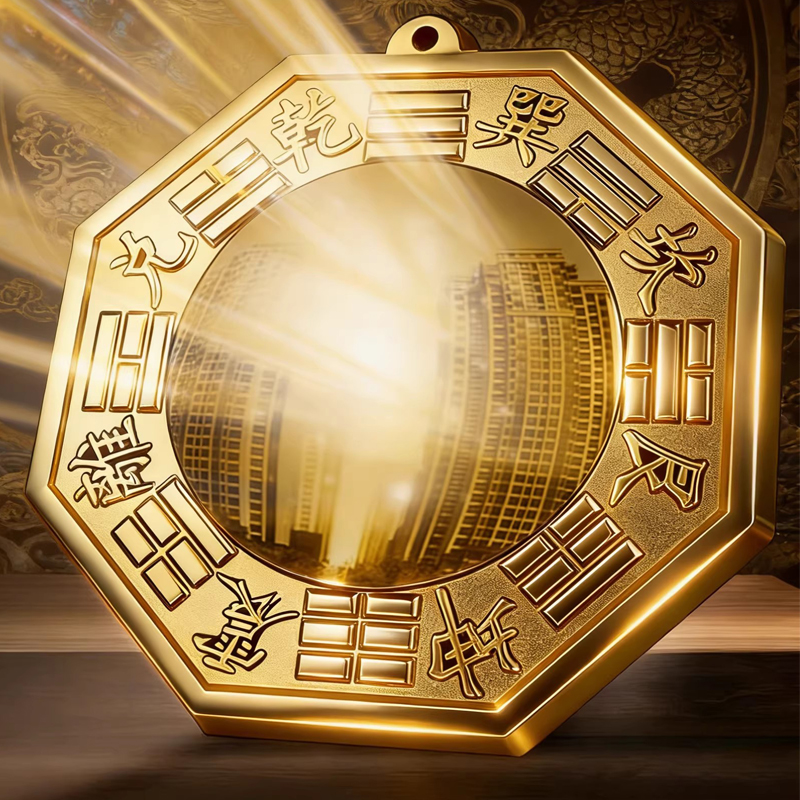
II. Classification and Functions: The Wisdom of Three Mirrors in One
Bagua mirrors can be classified into convex, concave, and flat mirrors based on their surface shapes, each corresponding to different Feng Shui functions:
Convex Mirror: With a rounded, convex surface resembling a shield, the convex mirror is specifically used to resolve external evil spirits. When a residence faces煞气 (evil spirits) such as road rushes, reverse bow煞, utility poles, or sharp-cornered buildings, the convex mirror can refract the sharp Qi in all directions, transforming rigidity into softness. For example, if the front door of a residence directly faces a downward staircase (a “rolling curtain water”煞气), hanging a convex mirror can reflect the evil spirit and prevent the leakage of wealth.
Concave Mirror: Featuring an inward-curved surface resembling a treasure bowl, the concave mirror has the function of gathering. When a residence experiences the dissipation of earth Qi or the departure of auspicious objects, the concave mirror can reabsorb wealth and good fortune. For instance, a shop located at a crossroads can hang a concave mirror to “attract wealth and prosperity”; if the front door of a residence faces an elevator (a “scissors”煞气), hanging a concave mirror can remedy the problem of Qi being absorbed.
Flat Mirror: With a flat surface, the flat mirror has the most direct function—reflection. It is suitable for blocking the unfavorable shapes of outdoor buildings, such as wall corners or pointed skyscrapers. The flat mirror should be hung facing outward and should not be placed indoors to reflect people, as this may reflect auspicious Qi or cause psychological discomfort.
III. Usage Rules: Taboos and Considerations
The use of Bagua mirrors must adhere to strict rules; otherwise, they may backfire:
Hanging Time: The best times to hang a Bagua mirror are during the Chen (7-9 a.m.) or Wu (11 a.m.-1 p.m.) periods when Yang energy is at its peak, enhancing the mirror’s ability to resolve evil spirits.
Consecration Ritual: Bagua mirrors require Taoist consecration to imbue them with spiritual power. Unconsecrated mirrors are merely decorative and cannot exert Feng Shui effects.
Orientation Restrictions: No more than three Bagua mirrors should be hung throughout the entire house, with only one mirror per orientation. The mirror surface should not directly face deity statues, indoor living spaces, or other residences to avoid reflecting evil spirits onto neighbors and causing disputes.
Material Selection: Natural jade is the most effective material, followed by bronze and peach wood. Glass or plastic mirrors only have symbolic significance and possess weak Feng Shui effects.
Indoor Taboos: Bagua mirrors should not be hung in bedrooms, kitchens, bathrooms, or on ceilings. The strong energy field in bedrooms can cause insomnia; the conflict between kitchen grease and mirror reflections can attract trouble; and the unstable Qi flow on ceilings can cause headaches.
IV. Modern Applications: From Tradition to Innovation
In modern architecture, the applications of Bagua mirrors are increasingly diverse. For example:
Resolving Road Rushes: When the front door of a residence directly faces a road or elevated highway, hanging a convex mirror can reflect evil spirits and protect the home.
Adjusting Commercial Qi Fields: Hanging a concave mirror at the entrance of a shop can absorb wealth from the street and enhance business luck.
Alleviating Neighborly Conflicts: If the windows or doors of a residence directly face those of a neighbor, hanging a flat mirror can reflect evil spirits while avoiding direct conflict and maintaining harmony.
Optimizing Indoor Layouts: For unfavorable layouts such as beams pressing down on beds or bathrooms facing beds, Bagua mirrors can be used in conjunction with other Feng Shui tools (such as Five Emperor Coins or gourds) to resolve the issues.
V. Cultural Symbolism: The Pursuit of Harmony and Balance
The Bagua mirror is not only a Feng Shui tool but also an embodiment of the Chinese cultural concept of “harmony between humanity and nature.” Its Bagua symbols represent the changing laws of the universe, while the mirror surface symbolizes the fusion of heaven and earth Qi. By hanging a Bagua mirror, people attempt to find a balance point in a dynamically changing environment, achieving family harmony, career success, and physical and mental well-being. This pursuit essentially reflects humanity’s eternal yearning for a better life.
The Feng Shui Bagua mirror, with its profound historical heritage, scientific classification system, and strict usage rules, stands as a shining pearl in traditional Chinese culture. While respecting tradition, we should also adopt a rational attitude toward its efficacy—it may not change the objective environment but can add a sense of peace and confidence to life through psychological suggestion and Qi field adjustment.

Leave a Reply